|
South Australian Metropolitan Fire Service (SAMFS)
The SA Metropolitan Fire Service (SAMFS) uses the SAGRN for all
voice transmissions throughout South Australia. Its communications
centre (call sign Adelaide Fire) is located in the MFS Adelaide
Headquarters building and handles all call receipt and dispatch
functions for all MFS and CFS brigades as well as all SES units
throughout South Australia. Operators also control traffic lights in
the central business district of Adelaide and dispatch keys required to
gain access to city buildings.
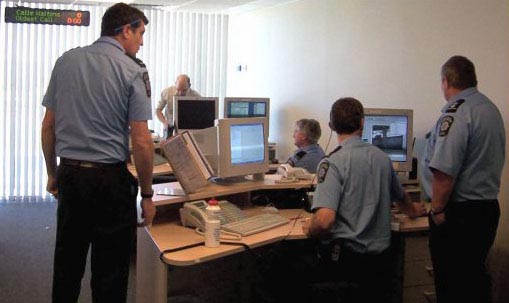 Temporary MFS Communications Centre
 Metropolitan fire appliances use a computer terminal mounted in the
vehicle for receiving information on incidents and also for sending
status messages. Station turnout is achieved through pager messages
sent to fire station terminals, these activate a fire station alerting
system and convert the text to voice for readout in the station.
The MFS has fire stations in many larger country towns, they rely on
retained firefighters who are required to carry SAGRN pagers for
incident notification. All emergency telephone calls are relayed
through to the Adelaide communications centre where details are taken
and a pager message is sent to the appropriate fire fighters.
Appliances transmit messages to the communications centre on the statewide talkgroup 150-MFS-DISP1
P25 UHF Simplex channels and additional talkgroups are utilised for fire-ground communications.
P25 Tactical / Fireground channels
| Channel |
Frequency |
NAC |
| 181 |
462.0375 |
181 |
| 182 |
415.475 |
182 |
| 183 |
422.6375 |
183 |
| 184 |
422.8875 |
184 |
| 185 |
426.0375 |
185 |
| 186 |
426.2875 |
186 |
| 187 |
415.475 |
187 |
| 188 |
422.6375 |
188 |
| 189 |
422.8875 |
189 |
| 190 |
426.0375 |
190 |
| 191 |
426.2875 |
191 |
|